Multiscale Modeling with Explicit Embedding Approaches in FHI-aims
Zoom: https://us06web.zoom.us/j/82570434598
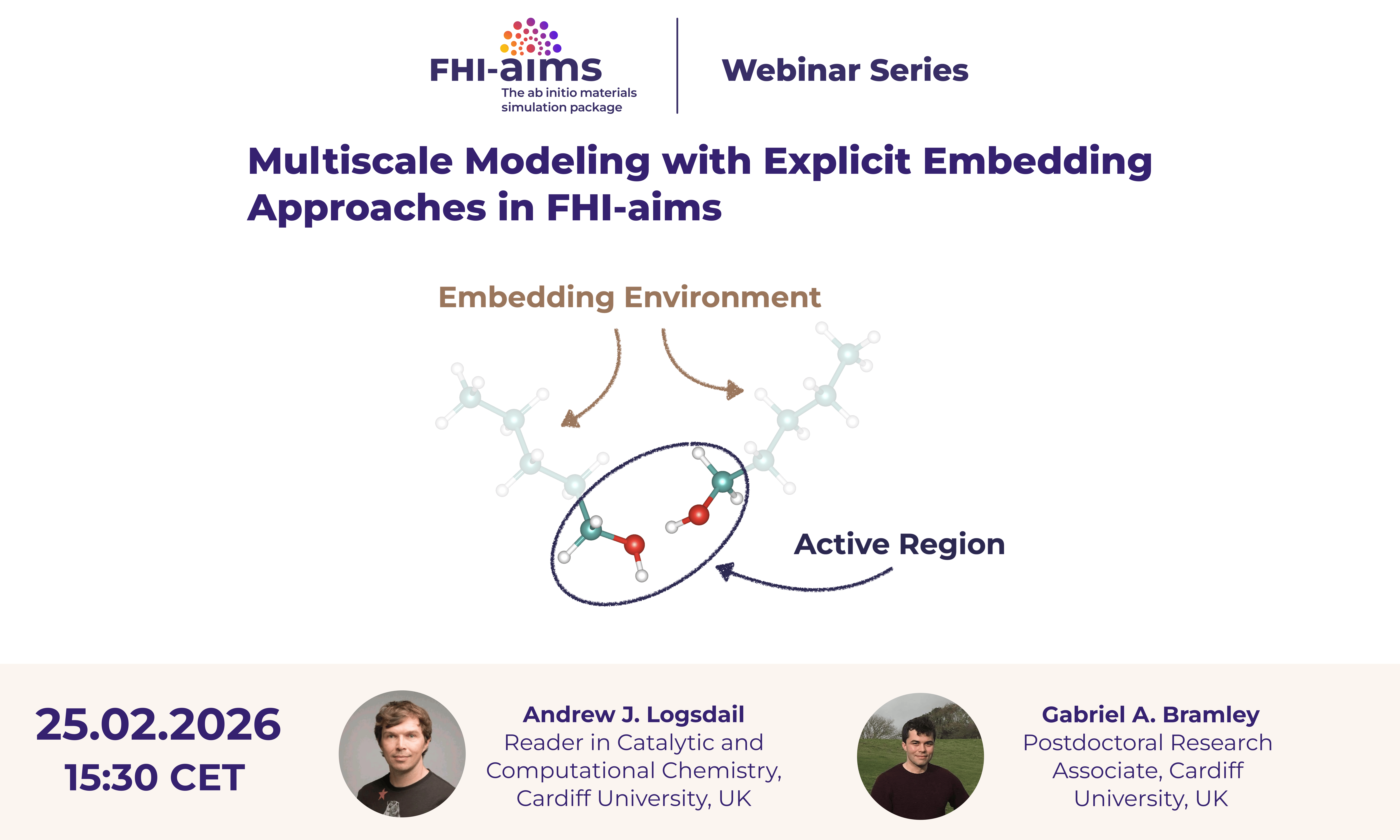
Join us for this webinar, consisting of expert talks and interactive hands-on sessions, on explicit embedding methods and their implementation in FHI-aims for the efficient simulation of complex molecular and periodic systems.
A fundamental issue we often face is that the systems we wish to study are too large for highly accurate methods. While high-level quantum mechanical calculations provide exceptional accuracy for electronic structure, their scaling with system size makes applications to realistic chemical systems computationally prohibitive. This challenge is particularly acute when studying catalytic active sites, defects in materials, or reactive regions within large molecular environments, where the chemistry of interest is localized to a small region.
Embedding methods address this challenge through a hierarchical approach that partitions the system into distinct regions treated at different levels of theory. By localizing the computationally expensive, high-accuracy calculations to the chemically active region while representing the wider environment with less expensive methods, embedding approaches enable the study of complex systems that would otherwise be intractable. Explicit embedding retains atomistic detail of the environment, with basis centres (typically atomic sites) that can be represented through various approaches including multipolar charges, pseudopotentials, or hierarchical basis representations. This contrasts with implicit embedding approaches, which model the environment as a continuous medium with dielectric properties.
This webinar will explore both the theoretical foundations and practical applications of explicit embedding, progressing from quantum mechanics/molecular mechanics (QM/MM) approaches to QM/QM methodologies. Andrew J. Logsdail will introduce explicit embedding in FHI-aims, with a focus on QM/MM approaches. He will demonstrate how these methods enable accurate calculations of complex systems, including heterogeneous catalysts, at reasonable computational cost.
Building on these QM/MM foundations, Gabriel A. Bramley will extend the discussion to QM/QM embedding, where different regions are treated with different levels of quantum mechanical theory, through the recently developed EmbASI framework, which allows for projection-based embedding with FHI-aims using the Atomic Simulation Interface (ASI). This approach facilitates both density functional theory in density functional theory (DFT-in-DFT) and wavefunction-in-DFT embedding calculations. The talk will show how EmbASI can achieve significant computational speedups, up to 50% acceleration in some cases, while maintaining accuracy within a few kJ/mol of full high-level calculations.
The accompanying online tutorial makes these advanced embedding techniques accessible to both computational experts and those new to multiscale modeling who want to leverage hierarchical quantum mechanics for materials design and chemical discovery.
What will be covered?
-
Discover the fundamental principles of explicit embedding, including QM/MM calculations with FHI-aims.
-
Learn about the EmbASI framework for efficient QM/QM calculations.
-
Participate in a guided hands-on tutorial using our cloud-based resources to run explicit embedding workflows with FHI-aims.
Both the webinar and hands-on session are free to attend without registration. The hands-on session addresses novice users of FHI-aims, but may also be interesting to experienced users. Following along and running the calculations in the AWS cloud is completely free, allowing you to gain practical experience with FHI-aims.
We provide resources for running the calculations during the hands-on session, but you need to register in advance to obtain access to the compute resources.
Register now!
Speakers:
Talk 1: Embedding approaches for multiscale atomistic simulations of solid-state systems
Andrew J. Logsdail
Reader in Catalytic and Computational Chemistry, Cardiff University, UK
Talk 2: QM-in-QM Embedding with the EmbASI Pythonic Wrapper
Gabriel A. Bramley
Postdoctoral Research Associate, Cardiff University, UK
When?
|
Webinar Talks + Q&A Wednesday, 25.02.2026: 09:30 - 11:00 EST (USA East) 15:30 - 17:00 CET (Europe) 20:00 - 21:30 IST (India)
|
Hands-On and Discussions Session 1 Thursday, 26.02.2026: 09:00 - 10:30 CET (Europe) 13:30 - 15:00 IST (India) 16:00 - 17:30 CST (China) 17:00 - 18:30 JST (Japan) |
Hands-On and Discussions Session 2 Thursday, 26.02.2026: 07:00 - 08:30 PST (USA Pacific) 10:00 - 11:30 EST (USA East) 16:00 - 17:30 CET (Europe)
|
The hands-on session will assume a basic understanding of the FHI-aims input files. If you don't have experience with FHI-aims, you can learn the first steps from this short YouTube video:
The Basics of FHI-aims