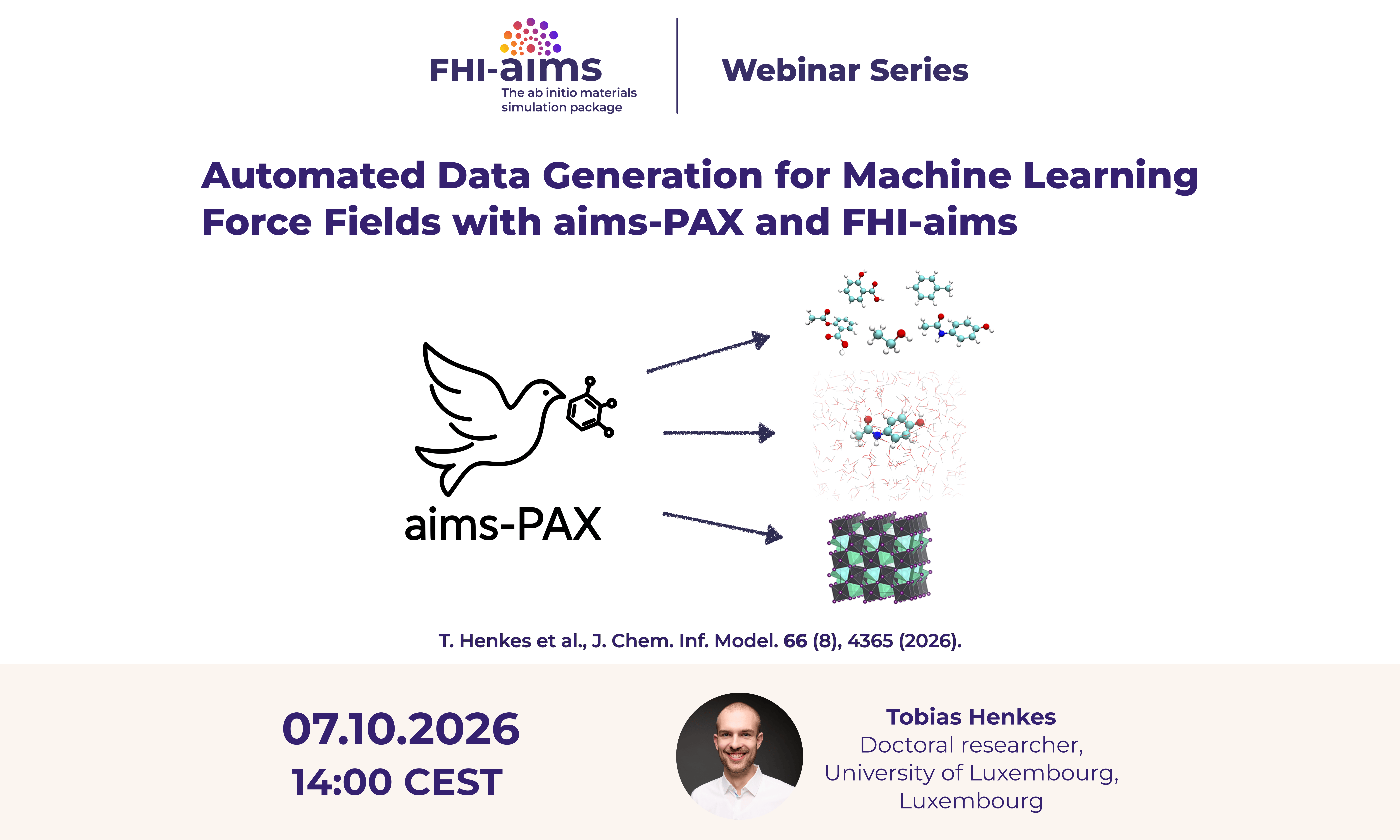
Automated Data Generation for Machine Learning Force Fields with aims-PAX and FHI-aims
Zoom: https://us06web.zoom.us/j/84093695453
(Calendar Entry / Zoom Link)
Join us for this webinar, consisting of an expert talk and interactive hands-on sessions, on automated data generation for machine learning force fields with aims-PAX and FHI-aims.
Machine learning force fields (MLFFs) have transformed molecular and materials simulations. They have become the method of choice for simulating the dynamics of large and complex systems, from flexible biomolecules to bulk materials, with near quantum-chemical accuracy at a fraction of the computational cost of ab initio methods. Yet the accuracy and reliability of any MLFF depends upon the data it is trained on. Collecting representative, high-quality reference data sets remains a bottleneck. It is often labor-intensive, requires expert knowledge, and consumes substantial computational resources.
Active learning has proven to be a successful strategy for addressing this data challenge, allowing the model itself to decide which configurations are most informative and should be labeled with expensive ab initio calculations. In this webinar, we will explore how aims-PAX (Parallel Active eXploration), a fully automated, open-source framework integrated with FHI-aims, streamlines the data generation process. Tobias Henkes will showcase how aims-PAX autonomously builds high-quality reference data sets by coupling diversified multi-trajectory sampling with scalable training across CPU and GPU architectures, and how general-purpose (often referred to as "foundational") force fields can kick-start data acquisition for diverse molecular and materials systems.
The webinar will demonstrate how aims-PAX reduces the number of required reference calculations by up to three orders of magnitude while enabling a 10-fold speedup in active learning time through optimized resource utilization. It will also demonstrate how the framework can generate data across gas-phase, solvated, and periodic systems, from highly flexible peptides and multiple organic molecules to explicitly solvated molecules and materials such as perovskites. Additionally, it will be shown how the automatically collected data sets are used to train state-of-the-art MLFF architectures such as MACE, making aims-PAX a versatile tool for data-driven force-field generation in both academic and industrial settings.
What will be covered?
-
Discover how to automatically generate high-quality reference data sets for machine learning force fields using parallel active exploration with aims-PAX and FHI-aims.
-
Understand how efficient CPU/GPU workload management substantially reduces the overall cost of data generation.
-
Participate in a guided hands-on demonstration on cloud resources to learn how to run these workflows with aims-PAX and FHI-aims.
Both the webinar and hands-on session are free to attend without registration. The hands-on session addresses novice users of FHI-aims, but may also be interesting to experienced users. Following along and running the calculations in the AWS cloud is completely free, allowing you to gain practical experience with FHI-aims.
We provide resources for running the calculations during the hands-on session, but you need to register in advance to obtain access to the compute resources.
Register now!
Speaker:
aims-PAX: Automated Data Generation through Parallel Active Exploration with FHI-aims
Tobias Henkes
Doctoral Researcher, University of Luxembourg, Luxembourg
When?
|
Webinar Talks + Q&A Wednesday, 07.10.2026: 08:00 - 09:00 EDT (USA East) 14:00 - 15:00 CEST (Europe) 17:30 - 18:30 IST (India)
|
Hands-On and Discussions Session 1 Thursday, 08.10.2026: 09:00 - 10:30 CEST (Europe) 12:30 - 14:00 IST (India) 15:00 - 16:30 CST (China) 16:00 - 17:30 JST (Japan) |
Hands-On and Discussions Session 2 Thursday, 08.10.2026: 07:00 - 08:30 PDT (USA Pacific) 10:00 - 11:30 EDT (USA East) 16:00 - 17:30 CEST (Europe)
|
The hands-on session will assume a basic understanding of the FHI-aims input files. If you don't have experience with FHI-aims, you can learn the first steps from this short YouTube video:
The Basics of FHI-aims